HONORS- INTRO TO SOCIOLOGY
  • Lessons
  • Course Documents
  • Syllabus
  • Lessons
  • Course Documents
  • Syllabus
Search

Symbolic Interactionism and Conflict Theory- DEVIANCE

5/16/2025

0 Comments

 
Deviance Activity Debrief
  1. What were the acts of deviance you did?
  2. What were the reactions you got? What variations?
    1. What kinds of sanctions were these?
  3. What have you learned about deviance from this activity?

Symbolic Interactionism and Deviance Lecture (if time)

Conflict Perspective Lecture

0 Comments

Functionalism and Deviance

5/13/2025

0 Comments

 
Take the Article Survey in Google Classroom!
There are 6 of you who still need to take this!

Functionalist Perspectives on Deviance Lecture

Take notes based on the slides.

Symbolic Interactionism and Deviance Lecture (if time)
  1. Differential Association
  2. Labeling
  3. Social Control

Review
  1. What is deviance?
  2. What are social norms?
  3. What happens when they are broken?

Generate a list of deviant acts
  1. Pair/share
  2. Get list on board
  3. Divide into criminal vs. non-criminal

Discussion
  1. Choose 5-8 items from list, pull from criminal and non.
  2. For each item, discuss the following:
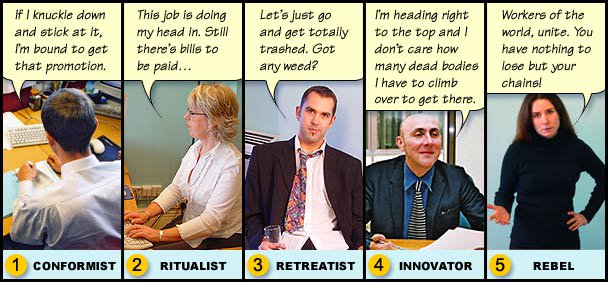
    1. What type of reaction is this? Rebellion, Retreatism, Conformity, Innovation, ??????
    2. What social norm is this breaking?  What are reactions to this?
    3. Why do you think people break this norm?
0 Comments

Gender and Inequality Quiz

5/12/2025

0 Comments

 
​Take the quiz!
0 Comments

Intro to Deviance

5/8/2025

0 Comments

 
Take Quick Feedback Survey for Sociology (you can keep this one brief- a more detailed reflection is coming next week)

Deviance Intro Lecture
  1. What is deviance?
  2. Exploring deviance
  3. Types of deviance
  4. Social Control
  5. Review of Sanctions
  6. Deviance as Social Construct
0 Comments

Masculinity Discussion + Study Guide

5/6/2025

0 Comments

 
Check Notes
Show me masculinity notes for men are lost and pew charts. 

Masculinity and Gender Roles Discussion + Writing
  1. What does it mean to be “masculine” or a man in the US today?
    1. What does the PEW survey reading point to here?
    2. How do you think this has changed from past ideas?
  2. Why is there the perception that changing gender roles is benefitting women more?
  3. In the article, what are the primary problems identified for young men?
    1. In work?
    2. In academics?
    3. In domestic life?
  4. What need is the “manosphere” (starts on page 4) addressing?  Why is it appealing?
    1. What is the difference between misogyny and being pro-male?
  5. Page 8- Why does the college student say that men don’t have the same types of role models women do? Why not?
  6. Why do some progressives minimize or avoid discussing men’s problems?
  7. On page 11, two different men propose what they think men should be. Do you agree? Disagree? Why?
  8. How do people earn or prove their masculinity? Page 12. 
  9. What needs to happen to address these issues? What changes do you think are necessary?

Study Guide for Quiz
Quiz on Monday

​
0 Comments

Crisis of Masculinity

4/29/2025

0 Comments

 
Review Discussion: Gender Based Violence
In table groups, spend 5 minutes reviewing and discussing the reading from last night.
  1. What stood out to you in this reading?
  2. What were the most important ideas?
  3. Do you think that pornography is bad for women? What about men? Why/why not?

Read and Take Notes: The Crisis of Masculinity
Read and take notes! 
  1. Main topics
  2. Main ideas/definitions
  3. Examples/Evidence
  4. Questions

Read and Take Notes: Pew Research
Read and take notes! 
  1. Main topics
  2. Main ideas/definitions
  3. Examples/Evidence
  4. Questions
0 Comments

Sexual Privilege + Gender Based Violence + Implicit Bias

4/28/2025

0 Comments

 
Reading Review/Discussion
  1. What patterns did we see in how gender inequality is seen across various fields?
  2. Which specific piece of research was most interesting or surprising to you?
  3. What accounts for the reversal in education (college enrollment, etc. on page 243)?
  4. Which of the types of gender inequality in this text have you experienced? When? What was the effect?
  5. What do you think is at the root of these inequalities? What is the most effective way to combat them?

​Sexual Privilege Survey
Take the survey. Then we will discuss the following questions:
  1. What were the scores?
  2. What patterns do we see here?
  3. Do we think one gender is privileged in our society? Why/why not? 
  4. How can we connect this to class concepts we studied last week?

Implicit Bias Test
Framing: This test shows attitudes that you may have that you are not even aware of. The attitudes may or may not influence your behavior, but they have been developed through socialization and cultural messages you have received. 
  1. Take either Gender/Career or Gender/Science
  2. What were the results?

Gender Based Violence
Read and take notes! 
  1. Main topics
  2. Main ideas/definitions
  3. Examples/Evidence
  4. Questions
0 Comments

Gender and Stratification

4/24/2025

0 Comments

 
Lecture: Gender and Stratification​​
​See slides linked above, and take good notes!


Textbook Chapter- Gender Inequality (DUE MONDAY)
Read this chapter. Take notes. Make sure you are capturing:
  1. Main topics
  2. Main ideas/definitions
  3. Examples/Evidence
  4. Questions
0 Comments

Gender vs. Sex + Gender Roles

4/22/2025

0 Comments

 
4 Corners
  1. Males are naturally better at math than females
  2. Women are naturally more nurturing and caring than men
  3. Men are biologically wired to be more aggressive and competitive than women
  4. Women have more privileges than men in today’s society
  5. Men are not judged by their appearance as much as women are
  6. Men and women are both judged harshly if they break their gender roles
  7. Traditional gender roles are beneficial to men and women

Ideal Man/Woman Drawing:
For either gender, as you draw, think about behaviors, physical attributes, and attitudes. What does society say is the ideal man/woman?
  1. Girls/Female Identifying- Draw and label a feminine woman
  2. Boys/Male Identifying- Draw and label a masculine man

What differences between males and females do you consider biological and which do you consider  social?  Fill out in pairs, then share out with the class. 
​
Discussion
  1. Where do we get our ideas of what it means to be masculine/feminine? Discuss, with specific examples.
  2. What’s the earliest memory you have of being placed into/encouraged to fit a specific gender role? What did that interaction teach you?
  3. To what extent do you think different gender roles are useful in society? Why might it be good to have clear gender roles? What are the downsides
  4. Do you think gendered behaviors/attitudes are more because of biology (innate) or culture (taught)? What supports this view for you right now?
  5. What messages have you received from society about how your gender is supposed to look and act?  Which of those messages do you follow, and which do you choose to ignore?

Reading- Textbook Chunk
Read the following chunk of textbook. As you read, you should make sure the following is included in your notes:
  1. Definitions of sex and gender, and the difference between the two
  2. Definition of sexual orientation
    1. Why it can be difficult to determine sexual orientation
  3. Evidence in support of biological gender roles/behaviors (make a list)
  4. Evidence in support of cultural gender roles/behaviors
  5. For different socializing institutions (family, peers, schools, mass media, religion)
    1. What messages are received
    2. 2 specific examples of how this works from the text
  6. 3 questions you have at the end of this reading.

HOMEWORK: 
  1. Finish reading + notes
  2. Watch 5 commercials. For each commercial, write down the following:
    1. What are they advertising?
    2. How do we see gender roles/socialization?

​
0 Comments

Institutional Discrimination Research

4/15/2025

0 Comments

 
Work Time Goals:
  1. Read and take notes on your second source
  2. Start reading the third source and take notes. Notes should include:
    1. Main ideas
    2. Evidence/specific examples (stats, quotes, #s, examples)
    3. Connections (especially between sources you are reading)
    4. Questions
  3. Test Corrections

Get Resources for Thursday/Friday Assessment Together
This assessment will be open-note and open-book. You may use all your resources. Here’s what I suggest you have with you:
  1. Readings
    1. Race is Real, but not Genetic
    2. Race Reading- The one you did on a specific racial/ethnic group
    3. Types of Prejudice
    4. 3 sources on Institutional Discrimination
  2. Notes
    1. Race and Ethnicity Intro (your notes + slides on Google Classroom)
    2. Race and Place/Time (your notes + slides on Google Classroom)
    3. Prejudice and Racism (your notes + slides on Google Classroom)
    4. Institutional Discrimination
    5. Discrimination Lecture Notes (notes from the video lecture from Monday 4/14)

There will be at least one question asking about your research on institutional discrimination. You will also be asked to apply concepts from lectures and notes to specific studies we have examined in class, or to examples you will be given. This kind of assessment is all about being able to make connections between concepts, and to apply the ideas to real-world scenarios or examples. 

​
0 Comments
<<Previous

    Author

    I've been teaching at AHS since the beginning- I love to explore ideas with students, and to help them bring their amazing ideas to fruition.

    Archives

    May 2025
    April 2025
    March 2025
    February 2025
    January 2025
    December 2024
    November 2024
    October 2024
    September 2024
    August 2024
    April 2023
    March 2023
    February 2023
    January 2023
    November 2022
    October 2022
    September 2022
    August 2022
    May 2020
    April 2020
    March 2020
    February 2020
    January 2020

    Categories

    All

    RSS Feed

Powered by Create your own unique website with customizable templates.
  • Lessons
  • Course Documents
  • Syllabus